

Global Automotive Cabin Air Quality Sensors Market Outlook (2025-2035)
Automotive Cabin Air Quality Sensors Market
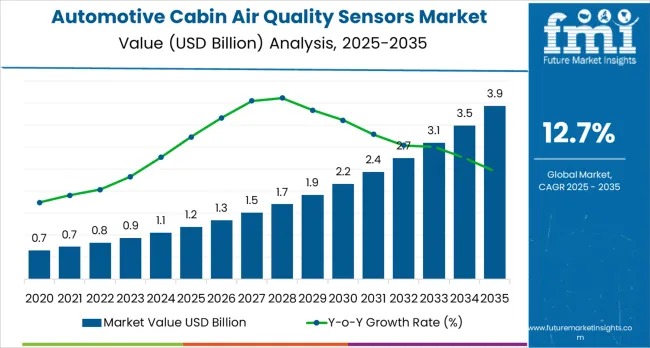
The automotive cabin air quality sensors market is projected to grow from USD 1.2 billion in 2025 to USD 3.9 billion by 2035, at a CAGR of 12.7%.
NEWARK, DE, UNITED STATES, February 2, 2026 /EINPresswire.com/ -- The global automotive cabin air quality sensors market is on a high-growth trajectory, projected to surge from USD 1.2 billion in 2025 to USD 3.9 billion by 2035, maintaining a robust CAGR of 12.7%. This growth is underpinned by a fundamental shift in automotive design: the transition of air quality monitoring from a luxury "add-on" to a standard health and safety requirement.
Strategic Market Pathways
The market is evolving through several distinct "Opportunity Pathways" that define how manufacturers and suppliers will capture value over the next decade.
• Pathway A: Passenger Car Dominance (73.26% Share)
Passenger vehicles remain the primary volume driver. As health-conscious design becomes a brand differentiator, manufacturers are moving beyond simple filtration to active sensing and automated purification responses.
• Pathway B: PM Sensor Leadership (63.0% Share)
Particulate Matter (PM) sensors are the "gold standard" for cabin air quality due to the direct medical link between PM2.5 exposure and respiratory health.
• Pathway C: Gas & VOC Detection (37.0% Share)
Detecting harmful gases like NOx, CO_2, and Volatile Organic Compounds (VOCs) is the next frontier, particularly for vehicles operating in heavy traffic or industrial corridors.
Request For Sample Report | Customize Report | Purchase Full Report
https://www.futuremarketinsights.com/reports/sample/rep-gb-6034
Regional Growth Analysis
The global automotive cabin air quality sensors market is characterized by a distinctive "peak-to-trough" expansion pattern, with growth trajectories varying significantly by region. Brazil leads the market with the highest projected CAGR of 13.3%, fueled by a rapidly expanding middle class and heightened urban pollution awareness. India follows closely with a 12.5% CAGR, where severe air quality crises in major metropolitan areas are transforming "health-first" features into a primary selling point for new vehicles. In the United States, a 12.2% CAGR is expected as the high adoption of premium electric vehicles and "smart" cabin features becomes the industry standard. Germany is projected to grow at 12.0%, sustained by a reputation for engineering excellence and the need to comply with strict EU environmental health standards. Finally, China maintains a strong 11.8% CAGR, driven by its massive electric vehicle manufacturing scale and aggressive government air quality mandates.
Key Market Drivers
1. The "Silent Cabin" Effect in EVs: In electric vehicles, the lack of engine noise makes passengers more sensitive to other environmental factors, including odors and air freshness.
2. IoT & Connected Platforms: Modern sensors are increasingly integrated with mobile apps, allowing owners to monitor cabin air quality remotely and "pre-scrub" the air before entering the vehicle.
3. Regulatory Pressure: Global mandates (particularly in East Asia and Europe) are tightening requirements for in-cabin $CO_2$ monitoring to prevent driver drowsiness and ensure adequate fresh air intake.
Challenges and Restraints
• Calibration Longevity: Maintaining sensor accuracy over a 10-15 year vehicle lifespan without frequent maintenance remains a technical hurdle.
• Miniaturization vs. Accuracy: Balancing the need for small, discreet sensor modules with the high sensitivity required to detect trace amounts of harmful gases.
Competitive Landscape
The market is dominated by tier-1 automotive suppliers and specialized sensor manufacturers:
• Honeywell & Bosch Sensortech: Leading the charge in high-accuracy PM and multi-gas detection.
• Sensirion & Amphenol: Focused on miniaturized, cost-effective modules for mass-market integration.
• Valeo: Providing integrated "Cabin Comfort" solutions that link sensors directly to advanced filtration hardware.
Similar Industry Reports
Automotive Air Flow Sensors Market
https://www.futuremarketinsights.com/reports/automotive-air-flow-sensors-market
Vehicle Cabin Air Quality & Filtration Test Systems Market
https://www.futuremarketinsights.com/reports/vehicle-cabin-air-quality-filtration-test-systems-market
Low VOC TPE Compounds for Automotive Interior Air Quality Compliance Market
https://www.futuremarketinsights.com/reports/low-voc-tpe-compounds-for-automotive-interior-air-quality-compliance-market
Sudip Saha
Future Market Insights Inc.
+1 347-918-3531
email us here
Legal Disclaimer:
EIN Presswire provides this news content "as is" without warranty of any kind. We do not accept any responsibility or liability for the accuracy, content, images, videos, licenses, completeness, legality, or reliability of the information contained in this article. If you have any complaints or copyright issues related to this article, kindly contact the author above.
