

Organoids Market In 2029
Organoids Market Report
Organoids Market Size
Organoids Market Growth
The Business Research Company’s Organoids Global Market Report 2025 - Market Size, Trends, And Global Forecast 2025-2034
LONDON, GREATER LONDON, UNITED KINGDOM, January 12, 2026 /EINPresswire.com/ -- Organoids Market to Surpass $2 billion in 2029. Within the broader Healthcare Services industry, which is expected to be 10,759 billion by 2029, the Organoids market is estimated to account for nearly 0.1% of the total market value.
Which Will Be the Biggest Region in the Organoids Market in 2029
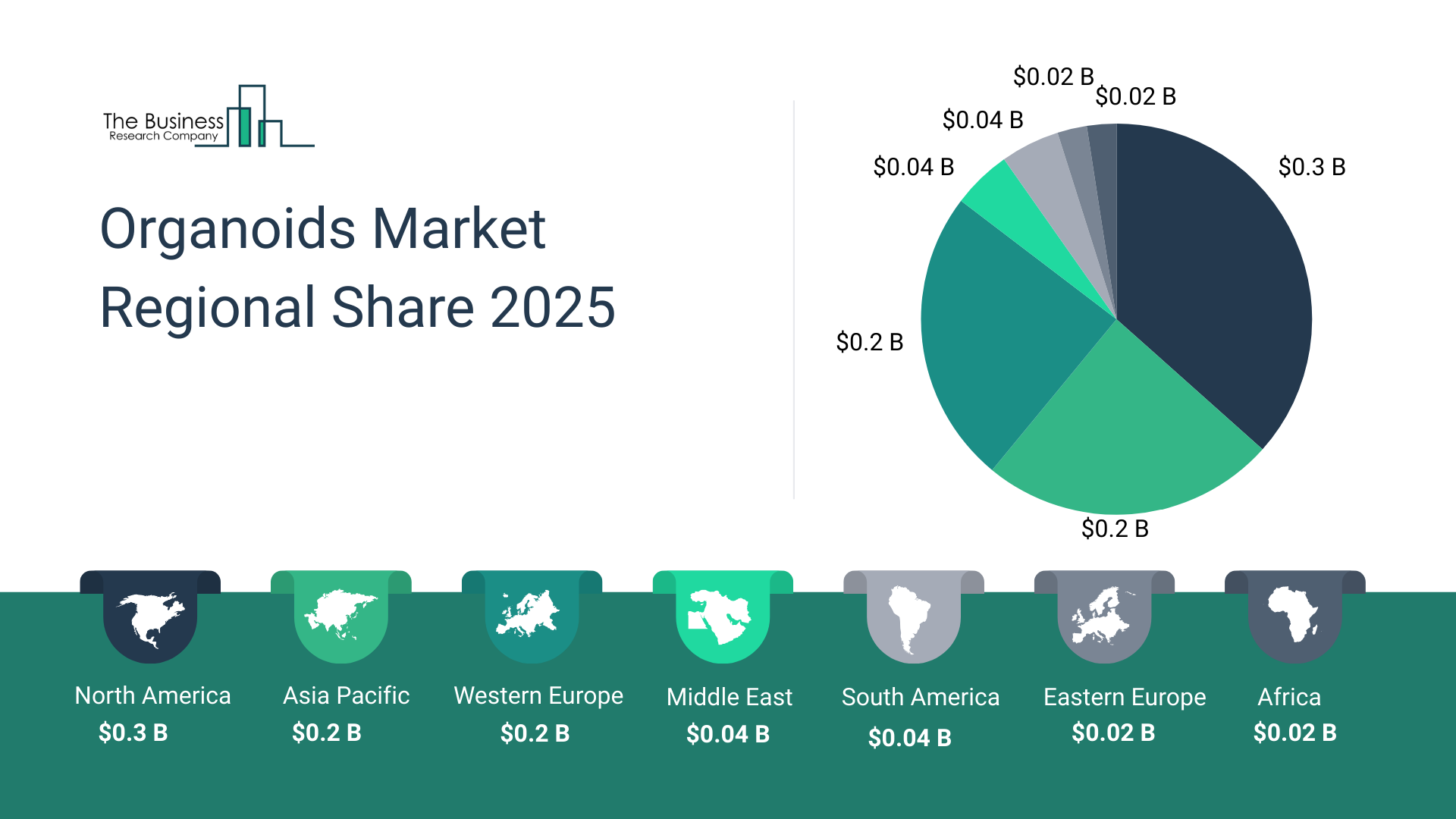
North America will be the largest region in the organoids market in 2029, valued at $617 million. The market is expected to grow from $261 million in 2024 at a compound annual growth rate (CAGR) of 19%. The rapid growth can be attributed to the rising development of biobanking and patient-derived models and rising prevalence of chronic diseases.
Which Will Be The Largest Country In The Global Organoids Market In 2029?
The USA will be the largest country in the organoids market in 2029, valued at $554 million. The market is expected to grow from $237 million in 2024 at a compound annual growth rate (CAGR) of 19%. The rapid growth can be attributed to the rising development of biobanking and patient-derived models and rising prevalence of chronic diseases.
Request a free sample of the Organoids Market report:
https://www.thebusinessresearchcompany.com/sample_request?id=10787&type=smp
What will be Largest Segment in the Organoids Market in 2029?
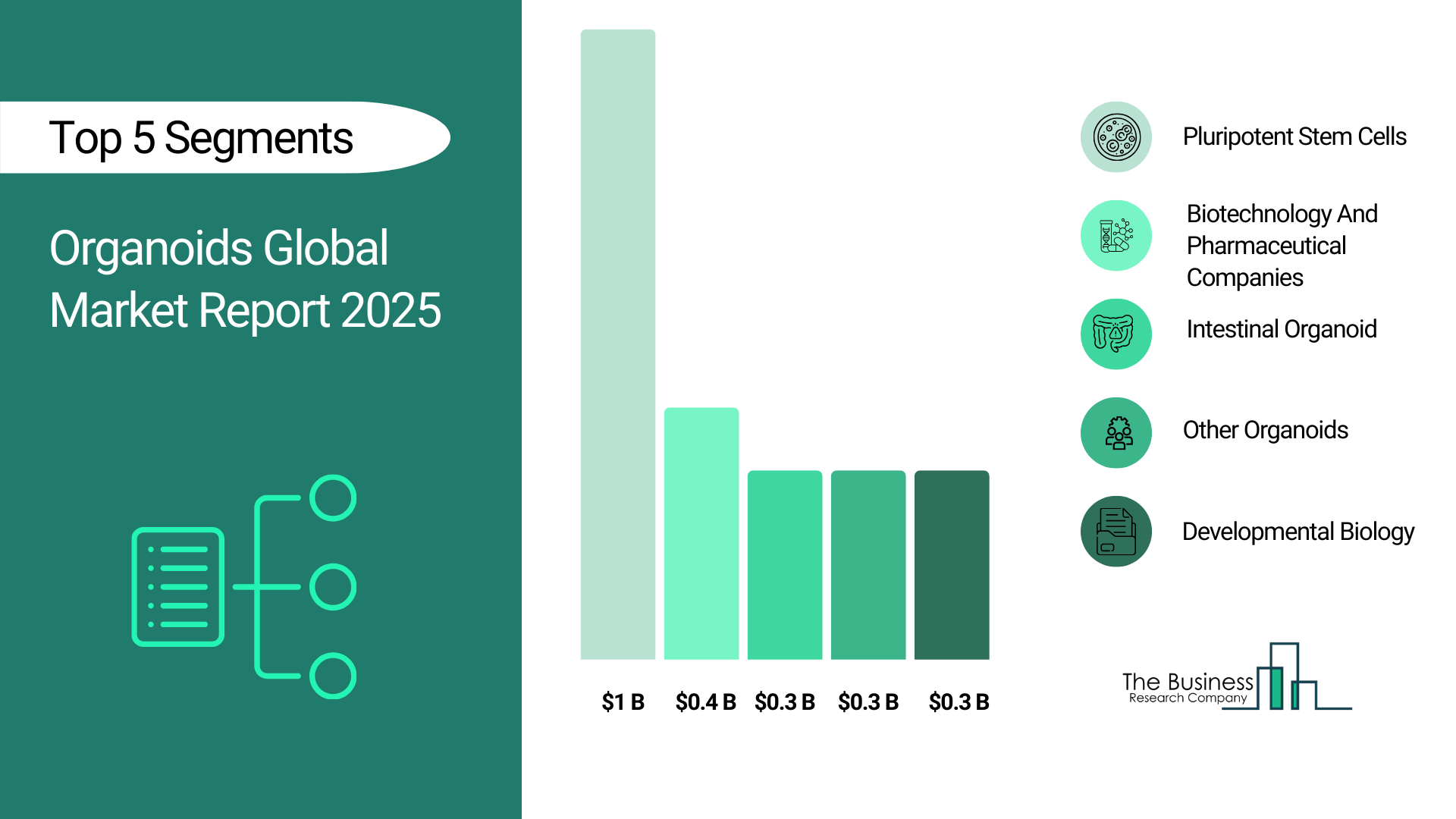
The organoids market is segmented by product into hepatic organoid, colorectal organoid, intestinal organoid and other organoid. The intestinal organoid market will be the largest segment of the organoids market segmented by product, accounting for 32% or $642 million of the total in 2029. The intestinal organoid market will be supported by demand for physiologically accurate gut models for nutrient absorption and microbiome studies, use in infectious disease research (e.g., enteric pathogens) and host–microbe interaction assays, relevance to oral drug absorption and transporter studies for pharmaceutical development, technical improvements in achieving regional (duodenum/ileum/colon) specification and barrier function, rising interest in inflammatory bowel disease and celiac disease research funding and expansion of organoid-on-chip platforms that increase throughput and translatable.
The organoids market is segmented by source into pluripotent stem cells and organ-specific adult stem cells. The pluripotent stem cells market will be the largest segment of the organoids market segmented by source, accounting for 59% or $1,189 million of the total in 2029. The pluripotent stem cells market will be supported by their broad differentiation potential enabling generation of multiple organ types from a single source, high reproducibility of protocols improving batch consistency, extensive methodological literature and commercial reagents that lower technical barriers, interest in disease modelling using patient-derived iPSCs for personalized approaches, scalability prospects for large-scale organoid production and regulatory attention to standardize iPSC-derived products for translational use.
The organoids market is segmented by application into developmental biology, disease pathology of infectious disease, regenerative medicine, drug toxicity and efficacy testing, drug discovery and personalized medicine and other applications. The developmental biology market will be the largest segment of the organoids market segmented by application, accounting for 24% or $478 million of the total in 2029. The developmental biology market will be supported by organoids’ ability to mimic early organogenesis enabling mechanistic studies, compatibility with genetic manipulation (CRISPR) for lineage tracing and functional dissection, use in modelling congenital disorders and developmental toxicity, growing availability of imaging and single-cell tools that reveal morphogenetic programs, academic funding prioritizing developmental questions and interdisciplinary collaborations (biology, engineering, computation) that accelerate insight generation
The organoids market is segmented by end-user into hospitals and diagnostic centres, biotechnology and pharmaceutical companies and other end-users. The biotechnology and pharmaceutical companies’ market will be the largest segment of the organoids market segmented by end-user, accounting for 38% or $759 million of the total in 2029. The biotechnology and pharmaceutical companies market will be supported by pharma’s drive to improve preclinical predictivity and reduce attrition, biotech innovation in protocol optimization and automation for scale-up, incorporation of organoids into CRO service offerings and discovery pipelines, strategic partnerships and licensing deals to access specialized models, investment in organoid-based platforms as competitive differentiators and regulatory engagement to qualify organoid readouts for safety and efficacy assessment.
What is the expected CAGR for the Organoids Market leading up to 2029?
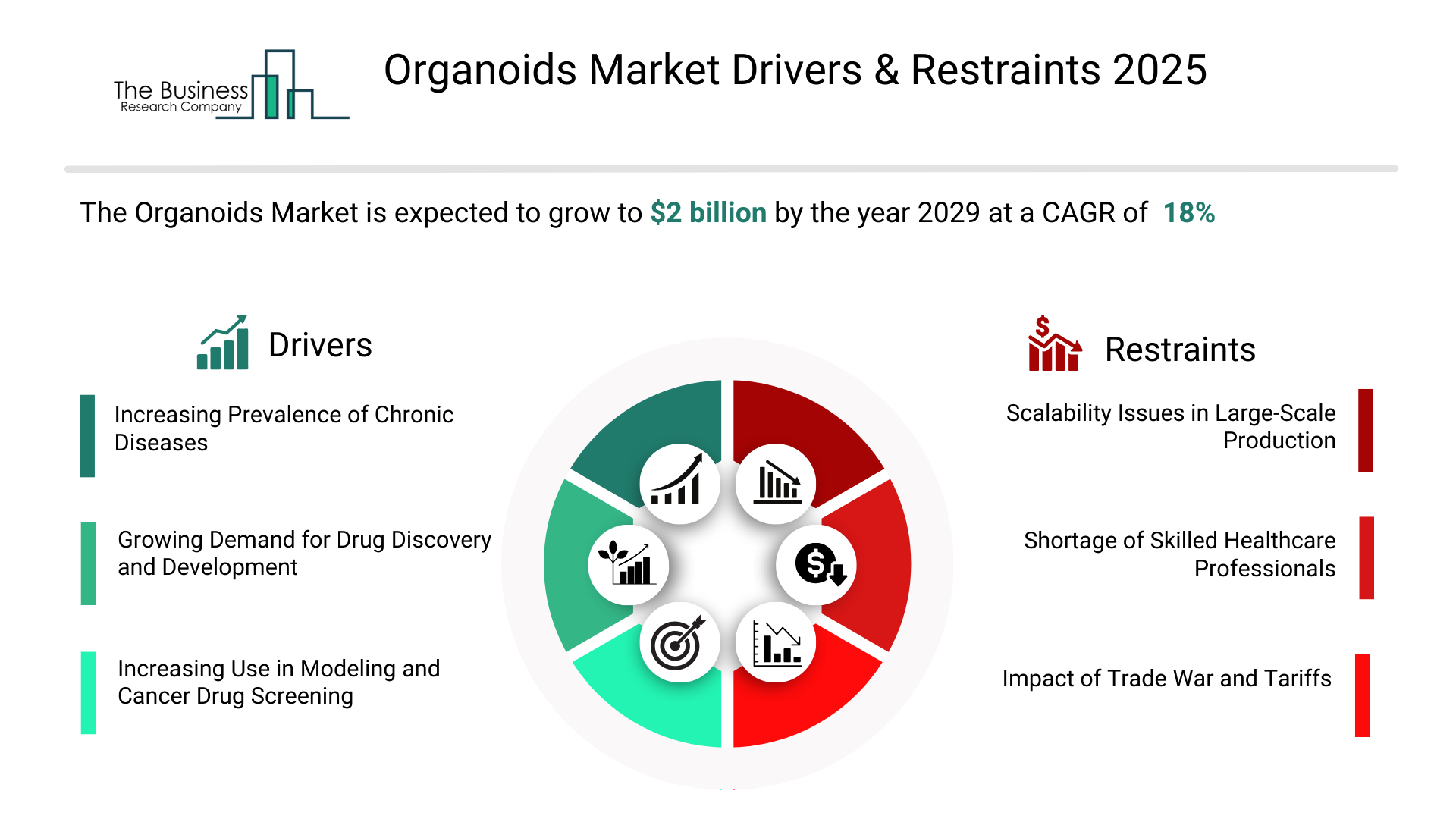
The expected CAGR for the organoids market leading up to 2029 is 18%.
What Will Be The Growth Driving Factors In The Global Organoids Market In The Forecast Period?
The rapid growth of the global organoids market leading up to 2029 will be driven by the following key factors that are expected to reshape biomedical research, drug discovery, and precision medicine worldwide.
Increasing Prevalence Of Chronic Diseases - The increasing prevalence of chronic diseases will become a key driver of growth in the organoids market by 2029. Chronic illnesses such as cardiovascular disorders, liver diseases, metabolic syndromes, and neurodegenerative conditions cannot be accurately studied using conventional 2D (two-dimensional) cell cultures or animal models. Organoids offer a more realistic representation of human tissue architecture and disease progression, enabling deeper insights into mechanisms behind long-term, progressive disorders. As chronic diseases continue to burden populations worldwide, research institutions, pharmaceutical companies, and clinicians will increasingly rely on organoids to design predictive models, assess therapeutic strategies, and identify early biomarkers. This shift toward more precise and efficient disease research will expand the application scope of organoids, leading to sustained market growth. As a result, the increasing prevalence of chronic diseases is anticipated to contributing to a 1.8% annual growth in the market.
Growing Demand For Drug Discovery And Development - The growing demand for drug discovery and development will emerge as a major factor driving the expansion of the organoids market by 2029. Pharmaceutical companies face increasing pressure to reduce development timelines, lower research costs, and improve therapeutic success rates. Organoids provide a powerful solution by serving as predictive human models that bridge the gap between preclinical testing and clinical trials. Their ability to reproduce functional characteristics of human organs helps researchers identify ineffective compounds earlier and better evaluate toxicity, dosage, and pharmacodynamics. As regulatory bodies and industry stakeholders increasingly encourage the use of human-relevant systems, organoids will play an expanding role in screening pipelines, mechanism-of-action studies, and validation of new molecular targets. Consequently, the accelerating growing demand for drug discovery and development capabilities is projected to contributing to a 1.3% annual growth in the market.
Increasing Use In Modelling And Cancer Drug Screening - The increasing use in modelling and cancer drug screening will serve as a key growth catalyst for the organoids market by 2029. Cancer research requires systems that closely mimic tumor microenvironments, cellular heterogeneity, and genetic variability, characteristics that organoids can replicate with high fidelity. Their ability to model cancer progression and drug response at a patient-specific level makes them invaluable for preclinical testing. As oncology continues to dominate global drug development pipelines, the need for accurate models that reduce failure rates and improve therapeutic precision will intensify. Organoids enable rapid, scalable testing of multiple drug combinations, allowing researchers to evaluate efficacy, toxicity, and resistance patterns more efficiently than traditional methods. This broadening use in cancer modelling and drug screening will increasingly position organoids as essential tools for personalized oncology and next-generation cancer treatment development. Therefore, this increasing use in modelling and cancer drug screening operations is projected to supporting to a 1.0% annual growth in the market.
Rising Development Of Biobanking And Patient-Derived Models - The rising development of biobanking and patient-derived models will become a significant driver contributing to the growth of the organoids market by 2029. Biobanks that store diverse and well-characterized organoids provide researchers with access to large repositories of biological material representing different diseases, genetic backgrounds, and demographic groups. These collections support high-throughput studies and enable companies to test drugs across a wide variety of patient types without requiring fresh tissue samples for every project. Patient-derived organoids offer unmatched relevance for precision medicine, as they preserve individual molecular signatures and allow for personalized treatment evaluation. As more institutions invest in systematically developing and maintaining these biobanks, the availability, standardization, and accessibility of organoids will improve dramatically. This infrastructure expansion will support collaborative research, accelerate clinical translation efforts, and ultimately fuel the market’s long-term scalability. Consequently, the rising development of biobanking and patient-derived models strategies is projected to contributing to a 0.8% annual growth in the market.
Access the detailed Organoids Market report here:
https://www.thebusinessresearchcompany.com/report/organoids-global-market-report
What Are The Key Growth Opportunities In The Organoids Market in 2029?
The most significant growth opportunities are anticipated in the organoid-based pluripotent stem cell research market, the organoid-based biotechnology and pharmaceutical solutions market, and the intestinal organoids market, and the organoid-enabled developmental biology market. Collectively, these segments are projected to contribute over $2 billion in market value by 2029, driven by advancements in stem cell engineering, the rising adoption of organoid platforms for drug discovery, and expanding applications across regenerative medicine and disease modelling. This surge reflects the accelerating shift toward 3D biological systems that offer higher physiological relevance, enabling more accurate testing, personalized treatment development, and improved translational research outcomes, fueling transformative growth within the broader organoids industry.
The organoid-based pluripotent stem cell research market is projected to grow by $696 million, the organoid-based biotechnology and pharmaceutical solutions market by $427 million, and the intestinal organoid market by $390 million, and the organoid-enabled developmental biology market by $262 million over the next five years from 2024 to 2029.
The Business Research Company (www.thebusinessresearchcompany.com) is a leading market intelligence firm renowned for its expertise in company, market, and consumer research. We have published over 17,500 reports across 27 industries and 60+ geographies. Our research is powered by 1,500,000 datasets, extensive secondary research, and exclusive insights from interviews with industry leaders.
We provide continuous and custom research services, offering a range of specialized packages tailored to your needs, including Market Entry Research Package, Competitor Tracking Package, Supplier & Distributor Package and much more
Disclaimer: Please note that the findings, conclusions and recommendations that TBRC Business Research Pvt Ltd delivers are based on information gathered in good faith from both primary and secondary sources, whose accuracy we are not always in a position to guarantee. As such TBRC Business Research Pvt Ltd can accept no liability whatever for actions taken based on any information that may subsequently prove to be incorrect. Analysis and findings included in TBRC reports and presentations are our estimates, opinions and are not intended as statements of fact or investment guidance.
The Business Research Company
Americas +1 310-496-7795
Europe +44 7882 955267
Asia & Others +44 7882 955267 & +91 8897263534
Email: info@tbrc.info
Oliver Guirdham
The Business Research Company
+44 7882 955267
info@tbrc.info
Visit us on social media:
LinkedIn
Facebook
X
Legal Disclaimer:
EIN Presswire provides this news content "as is" without warranty of any kind. We do not accept any responsibility or liability for the accuracy, content, images, videos, licenses, completeness, legality, or reliability of the information contained in this article. If you have any complaints or copyright issues related to this article, kindly contact the author above.
