

Tesla Mechanical Designs Leads the Way in Industry 4.0 Transformation with Advanced CAD Solutions
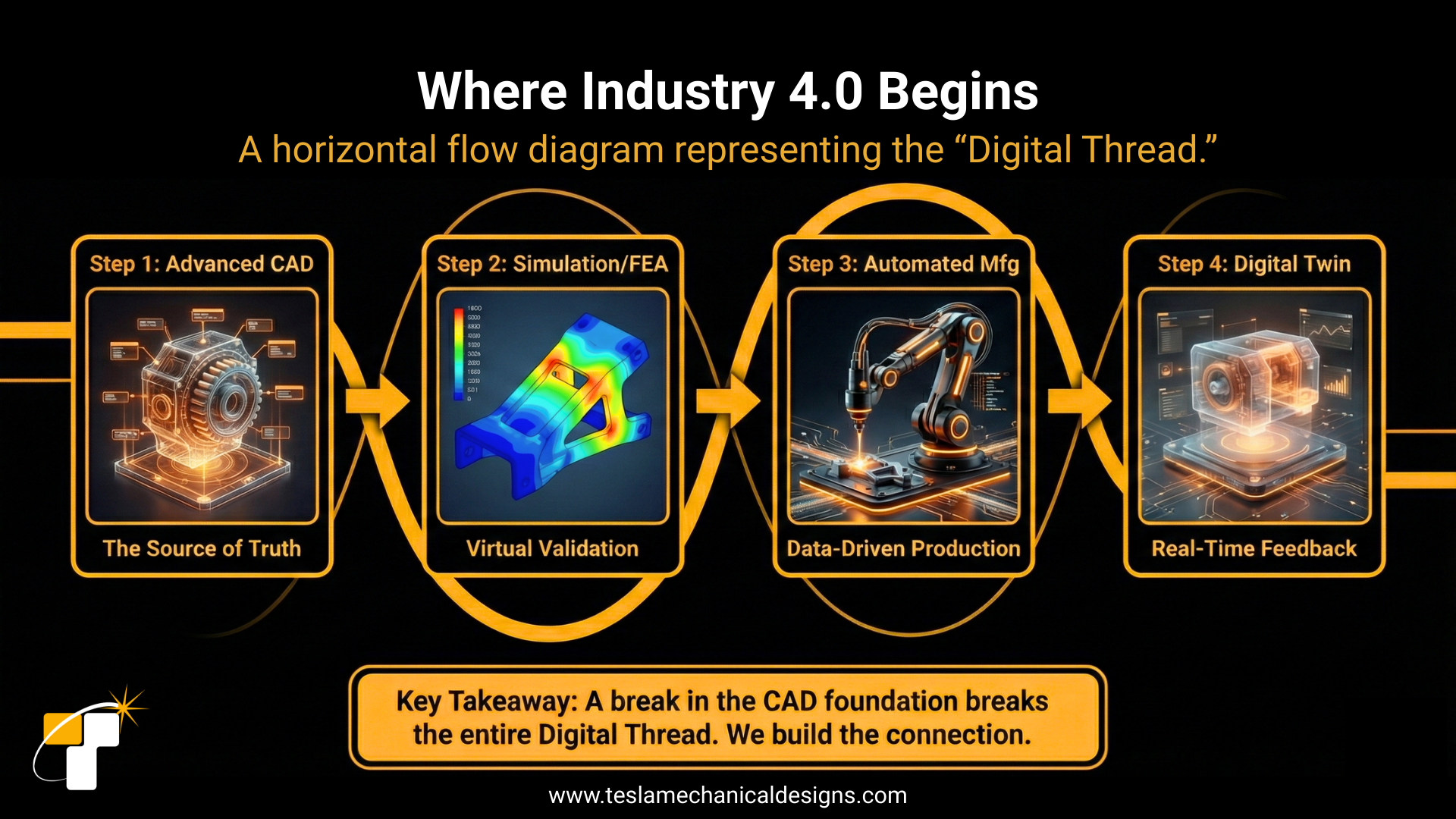
Advanced CAD is the critical source of truth for Industry 4.0.
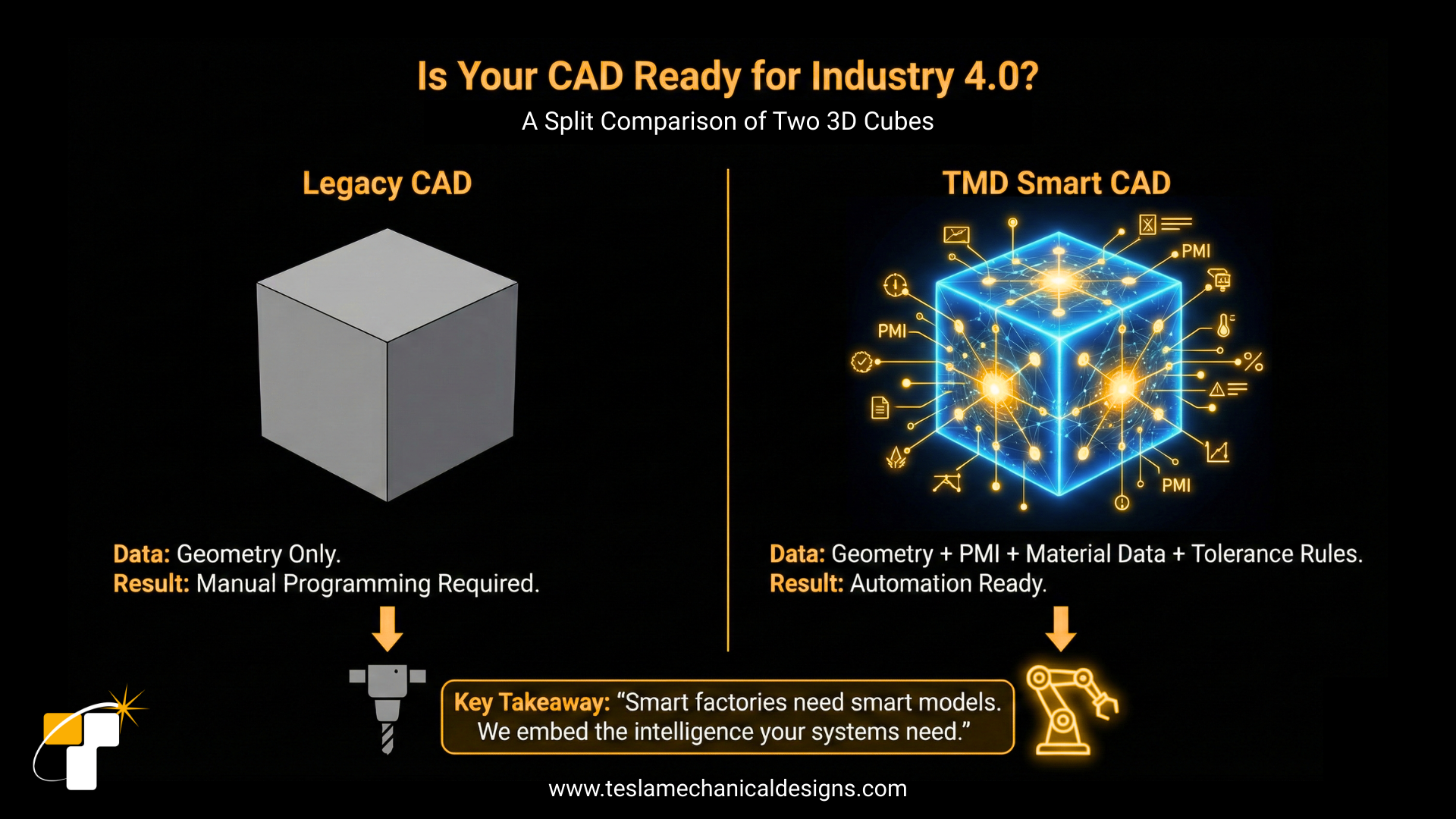
Legacy CAD provides geometry only; Smart CAD integrates data for full automation.
Report details how data-rich modeling connects design to the smart factory ecosystem and powers digital twins.
For over a decade, Tesla Mechanical Designs has partnered with global manufacturers to modernize their engineering workflows. Their latest findings emphasize that successful Industry 4.0 implementation is rarely a software issue; it is a data issue. Without intelligent, semantic CAD models acting as a "single source of truth," the digital thread breaks before it reaches the production line.
𝗙𝗿𝗼𝗺 𝗦𝘁𝗮𝘁𝗶𝗰 𝗗𝗿𝗮𝘄𝗶𝗻𝗴𝘀 𝘁𝗼 𝘁𝗵𝗲 𝗗𝗶𝗴𝗶𝘁𝗮𝗹 𝗧𝗵𝗿𝗲𝗮𝗱
In the traditional manufacturing model, CAD was primarily used to generate 2D drawings for fabrication. The data flow was linear and often terminated once the part was made. In an Industry 4.0 environment, however, this approach is obsolete. Modern manufacturing systems require a continuous "Digital Thread" where the design file feeds directly into simulation, CAM (Computer-Aided Manufacturing), inspection CMMs, and eventually, the Digital Twin of the physical asset.
Tesla Mechanical Designs identifies legacy CAD practices as the primary bottleneck in this transition. Models that lack semantic Product Manufacturing Information (PMI) or metadata cannot communicate effectively with downstream automation.
"A geometric model tells a machine what a part looks like, but an Industry 4.0 model tells the machine what the part is," explains the technical team at Tesla Mechanical Designs. "We are seeing a massive shift where clients need their CAD files to carry intelligence—tolerances, material properties, and lifecycle data—so that the factory systems can read and act on that data without manual intervention."
𝐁𝐫𝐢𝐝𝐠𝐢𝐧𝐠 𝐭𝐡𝐞 𝐆𝐚𝐩 𝐭𝐨 𝐃𝐢𝐠𝐢𝐭𝐚𝐥 𝐓𝐰𝐢𝐧𝐬
One of the most significant drivers of this shift is the rise of the Digital Twin—a virtual replica of a physical product used for real-time monitoring and simulation. Tesla Mechanical Designs reports that robust CAD modeling is the non-negotiable prerequisite for any Digital Twin strategy.
By utilizing advanced CAD 3D Modeling techniques, The Company ensures that the digital asset matches the physical asset with absolute precision. This fidelity allows manufacturers to run accurate simulations on the twin, predicting wear and tear or optimizing performance cycles before problems occur in the real world. This capability is helping global clients move from reactive repairs to predictive maintenance, a core promise of the Industry 4.0 revolution.
𝗞𝗲𝘆 𝗗𝗿𝗶𝘃𝗲𝗿𝘀 𝗳𝗼𝗿 𝗔𝗱𝘃𝗮𝗻𝗰𝗲𝗱 𝗖𝗔𝗗 𝗶𝗻 𝗦𝗺𝗮𝗿𝘁 𝗠𝗮𝗻𝘂𝗳𝗮𝗰𝘁𝘂𝗿𝗶𝗻𝗴
Tesla Mechanical Designs' report outlines five critical ways advanced CAD solutions are enabling the Industry 4.0 transformation:
✅ Interoperability across Systems: Smart factories rely on diverse software ecosystems. The firm emphasizes the need for neutral, data-rich CAD formats that retain integrity when moving between PLM, ERP, and MES systems.
✅ Model-Based Definition (MBD): The transition away from 2D drawings toward 3D MBD allows for automated tolerance analysis and inspection, reducing human error and speeding up quality control.
✅ Design for Automation: As robotics becomes more prevalent, CAD models must be optimized for automated assembly. The engineering company integrates robotic constraints directly into the design phase.
✅ Sustainability and Efficiency: Data-rich models allow for precise material calculation and waste reduction analysis during the design phase, aligning manufacturing with global sustainability goals.
✅ Seamless Customization: Advanced CAD enables the "lot size of one." By linking design parameters to sales configurators, manufacturers can automate the engineering for custom orders.
𝗧𝗲𝘀𝗹𝗮 𝗠𝗲𝗰𝗵𝗮𝗻𝗶𝗰𝗮𝗹 𝗗𝗲𝘀𝗶𝗴𝗻𝘀: 𝗘𝗻𝗴𝗶𝗻𝗲𝗲𝗿𝗶𝗻𝗴 𝘁𝗵𝗲 𝗦𝗺𝗮𝗿𝘁 𝗙𝗮𝗰𝘁𝗼𝗿𝘆 𝗙𝗼𝘂𝗻𝗱𝗮𝘁𝗶𝗼𝗻
Based in India and serving a global clientele, Tesla Mechanical Designs acts as the strategic architect for companies navigating the Industry 4.0 landscape. The firm combines deep expertise in traditional manufacturing services with cutting-edge digital capabilities, ensuring that every design asset is built to function within a modern, connected ecosystem.
The team leverages high-end platforms like Siemens NX, CATIA, and SolidWorks to create models that are not just geometrically perfect but digitally potent.
"The CAD file is no longer just a blueprint; it is the DNA of the smart factory," says the leadership team. "By ensuring that DNA is rich, accurate, and standardized, we empower our clients to unlock the full potential of their Industry 4.0 investments."
Divya Dave
Tesla Mechanical Designs
+1 214-699-6163
email us here
Visit us on social media:
LinkedIn
Bluesky
Instagram
Facebook
X
Legal Disclaimer:
EIN Presswire provides this news content "as is" without warranty of any kind. We do not accept any responsibility or liability for the accuracy, content, images, videos, licenses, completeness, legality, or reliability of the information contained in this article. If you have any complaints or copyright issues related to this article, kindly contact the author above.
